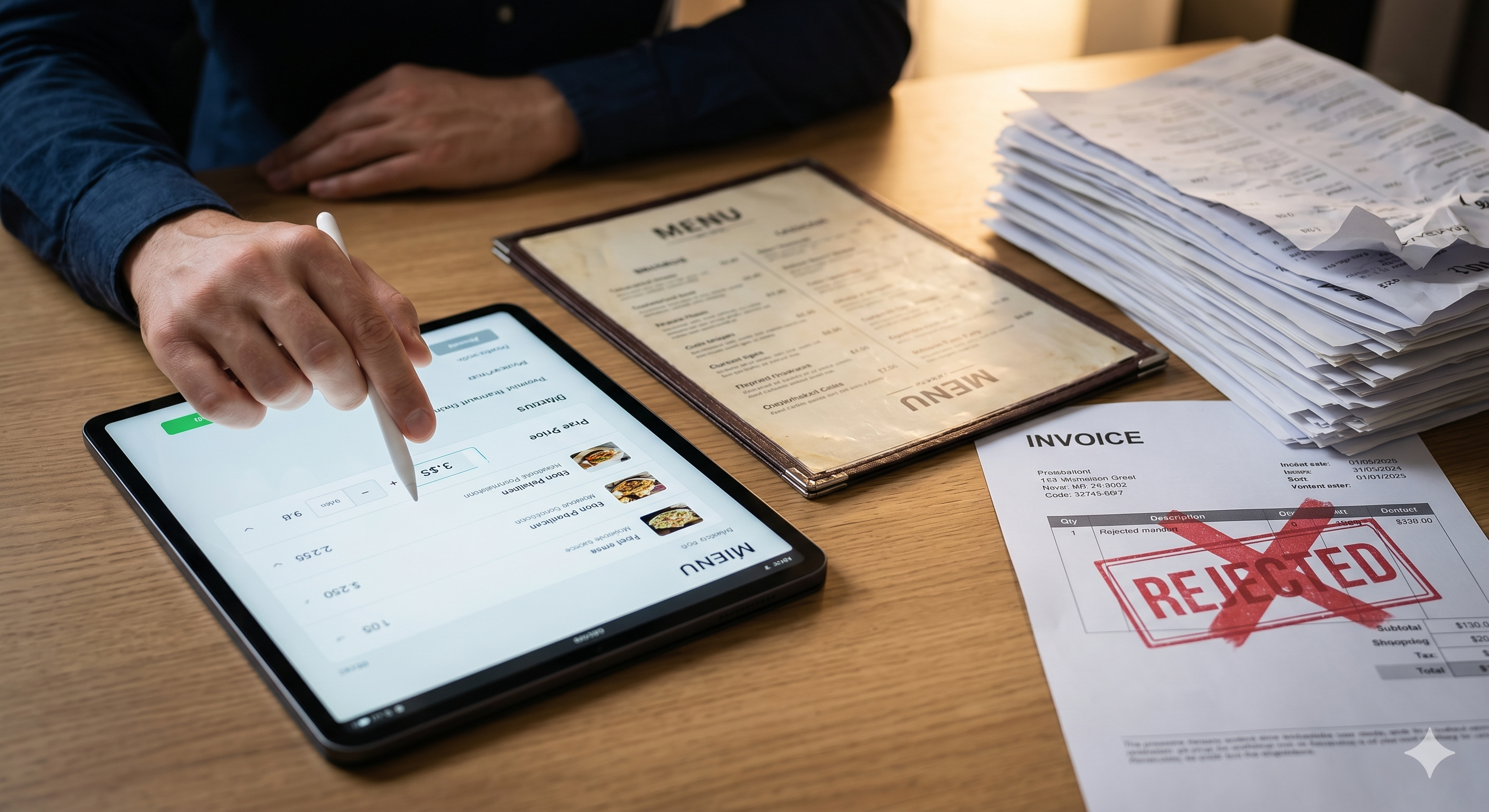
A printed menu seems like the safest option. It is tangible, professional, does not depend on internet. The problem is that it is expensive to print, slow to update and gets outdated the moment you change a price, add a dish or remove an item that ran out.
Restaurants that rely exclusively on printed menus spend hundreds on reprints per year — and still have the problem of customers seeing outdated prices or dishes that are no longer available.
Beyond the direct printing cost, there are indirect costs: the time to design the new version, send to the print shop, wait for delivery, replace all menus on tables. Any price change, no matter how small, can trigger this entire process.
With a digital menu, you update in real time from any device — phone, tablet or computer. Changed a price? 30 seconds. A dish ran out today? Mark as unavailable and it disappears from the customer view. New dish? Upload photo, add description and price, done.
The customer accesses via QR code on the table — points the camera, the menu opens. No app, no registration, no waiting.
Not necessarily. Many restaurants use a hybrid approach: a physical card with the main categories and a QR code that leads to the complete digital menu with all details, photos and prices. The best of both worlds.
In crdp.io you can create a complete digital menu with categories, items, photos and prices in a few minutes. The menu gets its own QR code and URL — you can share directly or print on tables.
Switching to a digital menu is not just about saving on printing — it is about having the flexibility to test prices, launch dishes and adapt the offer without bureaucracy. And in food service, speed of adaptation is a competitive advantage.
